Last Updated on December 14, 2025 by Wahid
Introduction
We all love T-shirts. They are soft, stretchy, and incredibly comfortable. But have you ever wondered why your T-shirt feels so different from your button-down dress shirt?
The answer lies in how the fabric is constructed.
While most formal clothes are “woven,” comfortable casual wear is almost always “knit.” Not knowing this difference is the most common reason people end up buying the wrong fabric for their projects.
In this guide, we will break down exactly what knit fabric is, how to distinguish it from woven materials, and tips for sewing these stretchy fabrics without frustration.
Woven vs. Knit: What’s the Difference?
To understand knits, you have to look closely at the structure.
Structure (Loops vs. Grid)
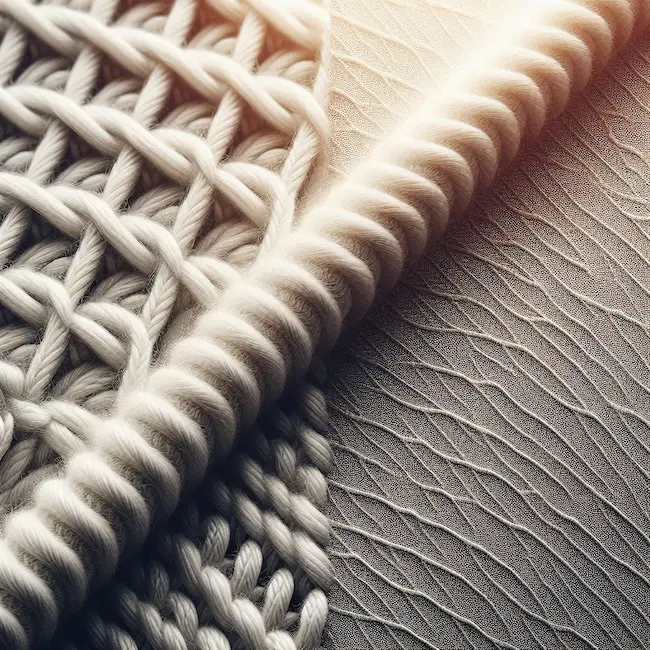
- Woven Fabric: Imagine a basket weave. Threads go over and under each other in a grid pattern (up and down, left and right). This creates a stable fabric with very little stretch.
- Knit Fabric: Imagine hand knitting with yarn, but on a microscopic scale. One continuous thread is looped back and forth. These interlocking loops act like tiny springs, giving the fabric its signature stretch.
The Visual Test: How to Identify?
If you are unsure whether a fabric is knit or woven, look for these three signs:
- The “V” Shape: Look closely at the texture. If you see tiny columns of “V” shapes (like braids), it is a knit. If you see a grid (#) pattern, it is woven.
- The Stretch Test: Pull the fabric. Knits stretch easily and bounce back. Woven fabrics usually have no stretch (unless Spandex is added).
- The Edge Curl: Cut a small piece. If the edges curl or roll up instantly, it is likely a Jersey Knit. Woven fabrics generally do not curl; they fray.
Wrinkle Resistance
Because of their looped structure, knit fabrics generally wrinkle less than most wovens, making them ideal for travel clothing.
Understanding “Stretch” & Recovery
Not all knits stretch the same way. The amount of stretch depends on the knitting style and the fiber content.
2-Way vs. 4-Way Stretch
- 2-Way Stretch: The fabric stretches only from side to side (selvage to selvage).
- Example: Standard T-shirts.
- 4-Way Stretch: The fabric stretches both side-to-side and up-and-down.
- Example: Leggings, swimwear, and activewear.
The Role of Spandex (Recovery)
Stretch is good, but “recovery” (bouncing back to the original shape) is better.
A 100% cotton knit might stretch out and become baggy over time. Stretch recovery largely depends on whether the fabric contains Spandex or Lycra. Even a small amount (3-5%) of synthetic elastic fiber helps the garment hold its shape for years.
Common Types of Knit Fabrics
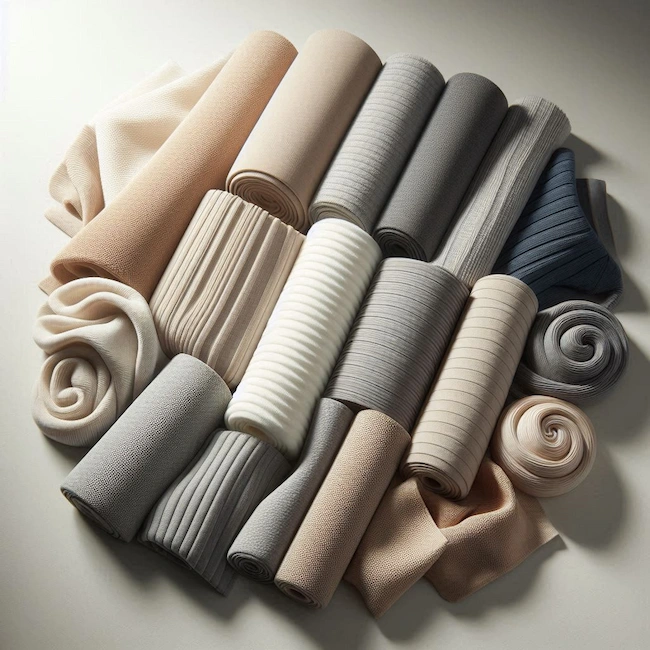
Here are the most popular knits you will find in stores.
Jersey Knit
This is the classic T-shirt fabric. It is lightweight, has a smooth face with vertical “V” lines, and a textured back.
- Note: The edges of Jersey knit will always curl towards the right side when cut.
Rib Knit
You will recognize this on the cuffs and collars of your sweaters. It has distinct vertical ridges (ribs) and is extremely stretchy.
Interlock
Interlock is a “double knit.” It looks the same on both sides (smooth) and is thicker and more stable than Jersey.
- Pro Tip: Interlock is easier to sew because the edges do not curl.
French Terry & Fleece
These are your go-to fabrics for sweatshirts and hoodies.
- French Terry: Has loops on the back. It is lighter and more breathable, making it good for mild weather.
- Fleece: The back is brushed to create a fuzzy, soft texture. It traps heat and is much warmer than French Terry.
Sewing with Knits: Why is it Tricky?
Sewing knits can be frustrating because standard machines are designed for stable woven fabrics. Common issues include skipped stitches and wavy seams. Here is how to fix them:
The Right Needle (Ballpoint)
Never use a sharp “Universal” needle. It can cut the knit loops, causing holes to run. Use a Ballpoint or Stretch Needle, which slides between the fibers.
The Right Stitch (Zigzag)
A straight stitch will snap when the fabric stretches. Use a Zigzag Stitch or a “Lightning Bolt” stitch so the thread can stretch with the fabric.
Presser Foot Pressure
If your seams look wavy (like a lettuce leaf), your machine is pressing down too hard. High presser foot pressure stretches the fabric as you sew. Lower the pressure or use a Walking Foot to feed the layers evenly.
Care and Maintenance
- Washing: Wash knits inside out to reduce pilling and surface wear.
- Shrinkage: Cotton knits can shrink significantly (up to 10%). Always pre-wash your fabric before sewing.
- Heat Sensitivity: High heat can damage the elasticity of the fabric (especially if it contains Spandex), causing it to become brittle. Tumble dry on low or air dry.
Conclusion
Knit fabric is the king of comfort. Whether you are making a simple tee or a pair of yoga pants, this knit fabric guide has hopefully demystified the process for you.
Understanding the difference between Jersey, Rib, and Interlock will help you get professional results. While sewing them requires a bit of practice, the result is a garment that moves with you.
Frequently Asked Questions (FAQs)
Why does my t-shirt hem curl up? This is a characteristic of “Jersey Knit.” The tension in the loops causes the edge to roll. Pressing it with starch or using a twin needle can help flatten it. (Future Guide: How to Sew Jersey Knit)
Is knit fabric always cotton? No. While cotton is common, knits can be made from polyester, rayon, wool, or blends.
Why do knits stretch out over time? If a knit fabric lacks elastic fibers (like Spandex) or is of lower quality, the loops may permanently deform after repeated stretching, leading to a “baggy” look.